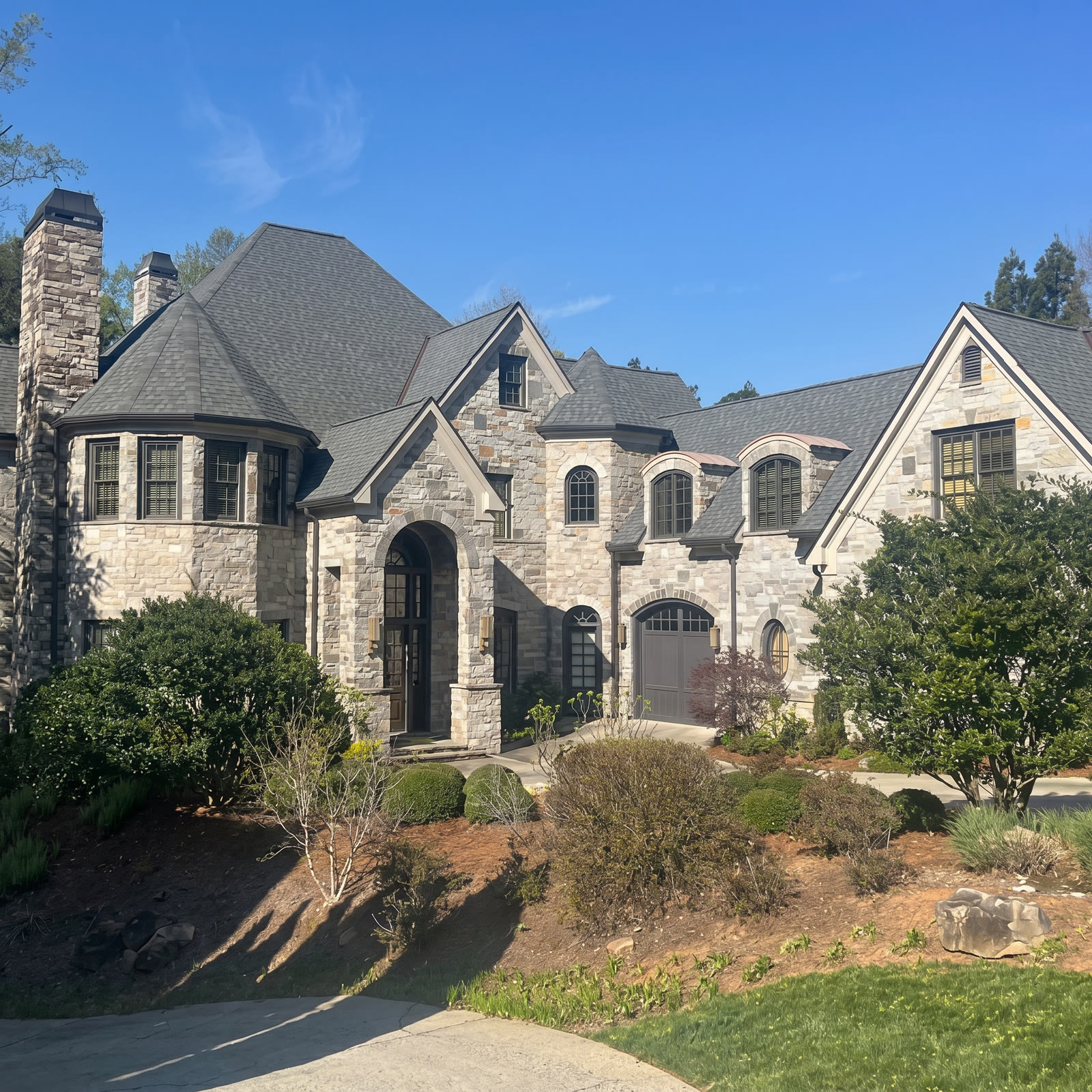
When the call came in on a Tuesday afternoon in late March, the homeowner did not say "hail damage." She said, "I have a brown spot on my dining room ceiling and I'm scared." That is almost always how it starts in Buckhead. The roof itself looks fine from the street. The lawn is immaculate. The shingles are seven years old. And yet, somewhere, water is finding a path.
This is what we found when we got there, what we did about it, and what every Atlanta homeowner should take away from a story that — frankly — could just as easily have been about a house in East Cobb, Sandy Springs, or Decatur.
The home and the storm
The home is a long-time Buckhead residence with a complex hip-and-valley roof and a chimney chase on one elevation. The shingles were GAF Timberline HD, dark gray, installed eight years ago by a contractor the homeowner described as "fine — they were the cheapest of the three I called."The storm in question rolled through Metro Atlanta on the evening of March 12, 2026. Local hail reports clustered between Buckhead and Sandy Springs, with golf-ball-sized stones reported at Chastain Park and quarter-sized stones reported on the Lenox corridor. The next morning, all the cars on the street had dimples and the homeowner's gutters were full of black grit she assumed was leaves.
It wasn't leaves. It was the protective granules that had just been pulverized off her roof.
What the inspection actually found
We sent Patrick out the following Monday for a free inspection. The homeowner had already filed an insurance claim, which we usually counsel against doing first — but in this case the visible interior damage gave her a legitimate basis. State Farm was scheduling an adjuster for the following week.Here is what Patrick documented in the inspection report:
- South-facing slopes: roughly 14 hits per 10x10 test square, average diameter 1.25", clear circular bruising with granule loss exposing the fiberglass mat
- West-facing slopes: 9 hits per test square, smaller average diameter (0.75"), some glancing-blow patterns indicating wind-driven hail
- Ridge cap: every ridge cap shingle had at least one bruise; six were cracked through the laminate
- Chimney flashing: intact, but the lead apron flashing on the south side had a clear circular indentation from a larger stone
- Gutters: four ten-foot sections of aluminum gutter with measurable dents on the upper face, three downspouts dented inward
- HVAC condenser: comb-style aluminum fins flattened on roughly 30% of the coil face — a real, claimable item most homeowners don't know to flag
- Window screens: three south-facing screens torn
The interior brown spot on the dining room ceiling was, for the record, not from this storm. It was a slow leak from a deteriorated rubber pipe boot on the master bath plumbing vent — probably leaking for six to nine months. We were honest about that in the report, even though it could have given us another insurance line item to push.
What this looked like in numbers
The Xactimate-format estimate Patrick prepared came in at **$71,420.86 in replacement cost value**, with **$53,265.74 in actual cash value** after a depreciation hold of $18,155.12 against the original 2018-vintage architectural shingles. After her $2,500 deductible, the first check from State Farm covered ACV minus deductible — the recoverable depreciation came on a second check once the work was completed and we sent in the certificate of completion. End of the day, the carrier was on the hook for roughly **$68,920** to make her whole.The breakdown (rounded):
- Tear-off and replacement of the entire roof system (40.6 squares, complex hip-and-valley with two roof pitches): $48,650
- Lead pipe boot replacements (6 vent stacks): $1,820
- Chimney chase flashing — full step and counter, plus new lead apron and cricket: $3,950
- Skylight curb flashing and new flashing kits (2 fixed VELUX): $2,140
- Gutter replacement (full perimeter — six-inch K-style aluminum, since matching the prior color in discontinued sections is impractical): $7,840
- HVAC fin combing and recoat (one main + one mini-split condenser): $620
- Window screen replacement (3): $185
- Code upgrades (synthetic underlayment, full ice and water shield at valleys/eaves/penetrations, six-inch nailing pattern, upgraded drip edge gauge): covered via her policy's $5,000 ordinance and law endorsement
- Detach and reset of solar attic fan + new flashing: $560
- Permits, dump fees, jobsite supervision, and final cleanup: $2,140
State Farm's adjuster came out April 2 and approved 94% of the line items as written. The pushback was on the gutter scope and the chimney chase rework — the carrier initially wanted to pay for only the visibly dented gutter sections and a like-for-like flashing replacement. Patrick walked the adjuster around the house and demonstrated two things: the existing gutter is a discontinued color from a manufacturer that no longer ships matching ten-foot sections, and the chimney saddle behind the chase had been improperly built without a cricket on the original install (visible by the rust pattern under the flashing) and would not pass current code on a re-cover. Once both items were documented on the supplement, the full scope was approved. This is a frustrating fight homeowners have to have constantly, and almost always lose without a contractor present.
The install
We replaced the roof on April 18, 2026 — a single-day install with a ten-person crew on a 40-square hip-and-valley layout. The sequence is the same one we wrote up in the [Atlanta Homeowner's Guide to Roof Replacement](https://roofnowatl-mz5mweng.manus.space/blog/atlanta-roof-replacement-guide) — there is no special process for an insurance job, just a higher level of documentation.Materials installed:
- GAF Timberline HDZ shingles, Charcoal — same line, slightly upgraded substrate over the prior generation, Class 3 impact rating
- GAF FeltBuster synthetic underlayment across the full deck
- GAF WeatherWatch ice and water shield at all valleys, eaves, and around every penetration (six pipe boots, two skylights, one chimney chase)
- All new lead pipe boots — no rubber, ever, on a sun-exposed Atlanta roof
- All new step and counter-flashing at the chimney
- Continuous ridge vent replacing the previous box vents — the prior install had four 12" box vents on a roof that needed roughly 38 linear feet of continuous ridge vent for proper exhaust
- Soffit baffles added to maintain intake airflow that was being blocked by blown-in attic insulation in three bays
What changed in the attic temperature
Two weeks after the install, on a 92°F afternoon, we asked the homeowner to put a meat thermometer in her attic and report back. Before the install, with the same outdoor temperature, her attic logged 148°F at the midspan. After the install, with the corrected ventilation, it logged 117°F. That 31-degree reduction is the difference between shingles that achieve their full warranted lifespan and shingles that are already losing granules at year ten.It is also a noticeable difference on her August power bill, but we'll have to revisit that in a follow-up post.
What every Buckhead homeowner should take away
A few things this case made vivid:- Hail damage is not visible from your driveway. If a storm passes through your zip code with reported hail of any size, a free inspection is worth the half-hour. Granule loss is not.
- The "interior leak" is rarely from this week's storm. Old pipe boots, valley flashing failures, and missing nail seals create slow leaks that show up months later. Roof age matters more than recent weather.
- The carrier will fight on the line items they think you won't notice. Gutters, HVAC fins, screens, and code-upgrade endorsements get pushed back constantly. A contractor who shows up to your adjuster meeting is worth their fee — and we don't charge one.
- Box vents are obsolete. If your roof was installed with box vents and you're under-vented at the soffit, you have a roof that is aging in fast-forward whether or not you ever take a hailstone.
If you live anywhere in Buckhead, Brookhaven, Chastain Park, Sandy Springs, or East Cobb and you're not sure whether the March 12 storm — or any storm in the last 18 months — left damage on your roof, book a free inspection. We'll come out, document what we find, and tell you honestly whether you have a claim worth filing or whether you have a perfectly fine roof.
The dining room ceiling, by the way, is dry now.